

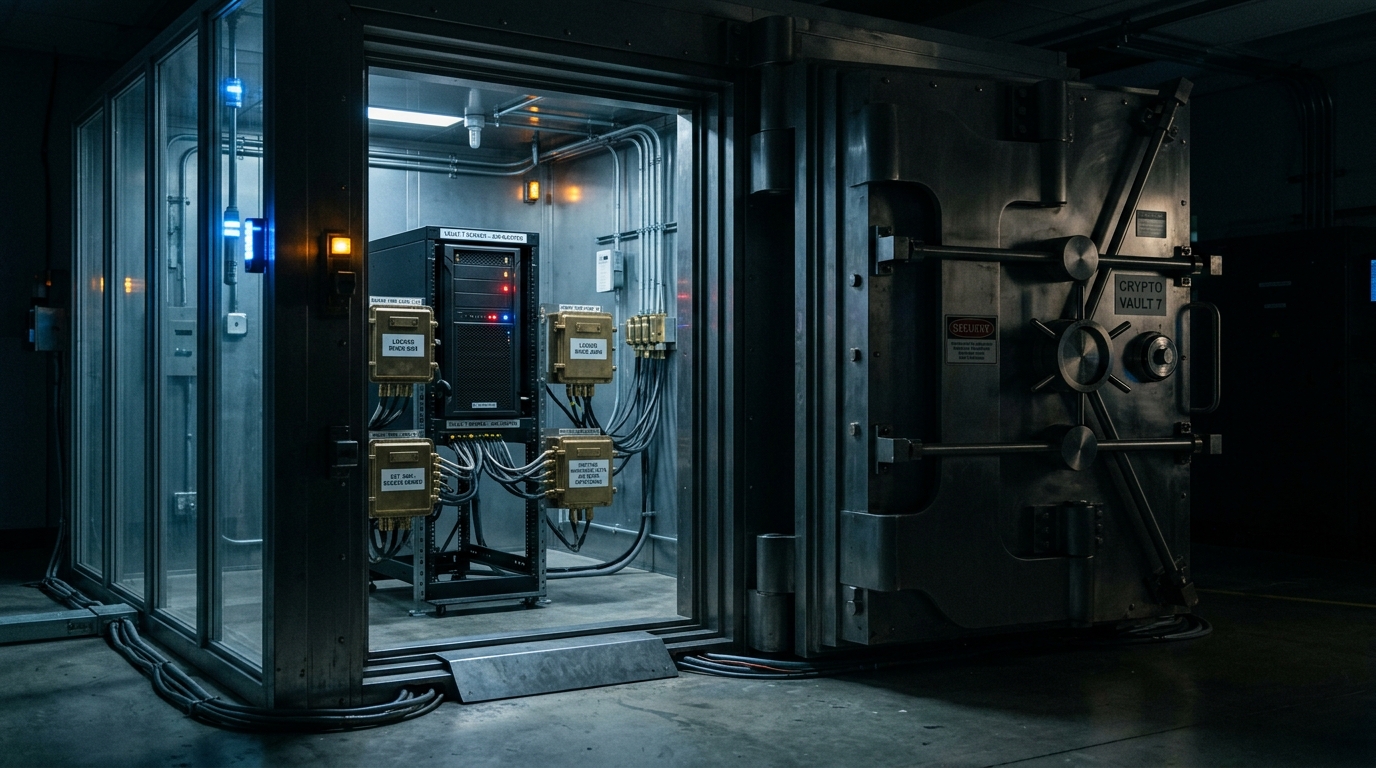
In empirical science, a testbed can only validate a hypothesis if the researcher has not inspected the testbed during the formulation of the hypothesis. In quantitative finance, this rule is violated universally. Researchers examine 2008 or 2020 market charts, subconsciously calibrate stop distances and indicator thresholds to survive those shocks, and then claim their algorithm “successfully navigated the Great Financial Crisis.” This paper formalizes the architecture of a true physical data air-gap: how candidate alphas discovered exclusively on modern datasets (2020+) are subjected to a single-shot, blind stress-test across two decades of uninspected historical crises (2001–2019) with zero parameter retuning permitted.
1. The Financial Observer Effect: Why Inspected Data is Dead
The human mind is a superlative pattern recognition machine. If a quantitative researcher knows that Lehman Brothers collapsed in September 2008, every filter, volatility trigger, and lookback window they write will inadvertently be conditioned on that event.
Even when automated machine learning algorithms are utilized, the researcher exercises subconscious selection bias: choosing feature subsets, loss functions, and regularization penalties that they already know yield favorable historical performance.
2. The Architecture of the Physical Data Air-Gap
Within the Ultron research pipeline, the historical database is physically partitioned into two air-gapped zones separated by strict cryptographic access controls:
Zone A: Discovery Space (2020 – Present)
Open to all quantitative research algorithms, machine learning models, and feature discovery agents. Models are formulated, trained, and iterated exclusively within this contemporary multi-asset data regime.
Zone B: Quarantined Vault (2001 – 2019)
Contains 19 continuous years of discrete Level-2/Level-3 market journals across global futures, equities, and FX. Access requires cryptographic multi-party authorization. Zero human querying or exploratory analysis is permitted.
The Single-Shot Execution Protocol
When an alpha candidate passes all in-sample discovery screens, CPCV splits, and placebo falsification tests in Zone A, its exact binary bytecode is cryptographically sealed (SHA-256). The sealed binary is dispatched to Zone B for a single-shot historical backtest.
If the candidate fails any performance or drawdown invariant during the 2001–2019 blind test, the model is permanently destroyed. Researchers are strictly forbidden from modifying parameters to “fix” the failure. Retrying an altered version against Zone B constitutes data contamination and invalidates the entire research lineage.
3. The 5 Quarantined Historical Crises
Zone B exposes candidate models to five structural market dislocations that modern machine learning algorithms trained on recent data have never witnessed:
Structural Shock: Severe equity multiple compression, tech sector liquidation, NASDAQ -78% drawdown.
Validation Gate: Tests strategy behavior during protracted equity deflation with widening credit spreads.
Structural Shock: Subprime mortgage collapse, Lehman bankruptcy, cross-asset liquidity freeze, VIX spike to 89.5.
Validation Gate: Verifies fail-closed margin protection, counterparty contagion resistance, and liquidity freeze survival.
Structural Shock: Intraday equity flash crash, Greek/Italian sovereign bond spreads blowouts, Euro parity threats.
Validation Gate: Tests orderbook queue depletion survival and macro currency regime divergence.
Structural Shock: SNB removes 1.20 EURCHF floor (thousands of pips in minutes); unexpected PBoC currency devaluation.
Validation Gate: Validates non-Gaussian jump-diffusion handling and hard broker slippage limits.
Structural Shock: VIX futures jump 115% in a single trading session, causing complete structural blowup of short-vol ETNs.
Validation Gate: Proves candidate strategy holds no latent short-volatility exposure or negative tail skew.
4. The Zero Grid Sweep Law: Rejecting Parameter Brute-Force
Commercial quant shops frequently execute multi-thousand node GPU “grid sweeps” to find optimal moving average lengths, RSI thresholds, and stop distances. This is mathematical self-delusion. A parameter space with 5 degrees of freedom tested over 100 values each creates 10,000,000,000 permutations—guaranteeing that multiple combinations will fit historical noise purely by statistical coincidence.
Under Qlumina institutional governance, all strategy parameters must be derived analytically from fundamental market microstructural invariants (such as exchange settlement cycles, central bank liquidity auctions, and order-book queue turnover times)—never from empirical grid sweeps.
5. Institutional Due Diligence: 5 Forensic Questions for Allocators
Institutional allocators and family office investment committees evaluating systematic managers should demand verifiable documentation on the following 5 air-gap governance questions:
Institutional Synthesis: Protecting Empirical Truth
The greatest vulnerability in quantitative finance is not bad math; it is human cognitive leakage. Once a researcher has observed a historical crisis, their brain cannot un-see it, and any model calibrated on that data is contaminated by hindsight.
By physically air-gapping 19 years of historical crisis regimes and enforcing a single-shot, zero-retuning execution protocol, Qlumina ensures that backtests represent authentic predictive skill rather than retroactive historical adaptation.
Audit Our Blind Air-Gap Verification Proofs
Institutional allocators and family office diligence teams can inspect cryptographically hashed strategy manifests, blind out-of-sample tear sheets, and crisis recovery logs within our secure institutional data room.