
Investor Guide
Investor Guide

The Investor
Guide.

A complete institutional reference — regulation, investment structures, systematic AI process, risk architecture, and onboarding.

Chapter 01

Understanding Qlumina

Qlumina (pronounced Q-Lumina, from quantitative science and computational illumination) is an AI-native asset management firm that designs, evaluates, and manages investment programs across multiple structures — Separately Managed Accounts (SMAs), Actively Managed Certificates (AMCs), and hedge funds. We combine systematic, technology-driven research with rigorous human oversight to source, validate, and allocate to investment strategies across global markets.

Our philosophy is built on the conviction that artificial intelligence and systematic data analysis can meaningfully improve the sourcing, evaluation, and risk management of investment strategies — while final investment decisions and fiduciary oversight require experienced human judgment. We identify high-quality portfolio managers and strategies through technology-enhanced due diligence and offer access through the structure best suited to investor needs.

BVI Company
No. 2201896BVI Business Company
Approved Manager
IBR/AIM/26/2644BVI FSC Approved Managers Regs. 2012
Legal Entity Identifier
9845000BG592F5189B91GLEIF International Standard
Registered Office
Road Town, TortolaRodus Building, P.O. Box 3093, VG1110, BVI

What BVI Approved Manager status means

An Approved Manager is a category of investment manager authorised by the British Virgin Islands Financial Services Commission to manage investment funds and accounts, subject to regulatory conditions including limits on the number of investors and/or assets under management, ongoing compliance obligations, and adherence to anti-money laundering (AML) and counter-terrorist financing (CTF) requirements. The regime is designed for professional and institutional investor-facing managers and provides a proportionate regulatory framework while maintaining internationally recognised standards of conduct and investor protection. Qlumina operates under the Securities and Investment Business Act, 2010 (SIBA), as administered by the BVI FSC.

Three institutional investment structures

Structure 01

Separately Managed Account (SMA)

Individually managed portfolios where the investor retains direct legal and beneficial ownership of all assets in their own segregated brokerage account.

Structure 02

Actively Managed Certificate (AMC)

Securitised investment products tracking a Qlumina strategy with an ISIN, issued through an institutional issuance vehicle or bank.

Structure 03

Hedge Fund Vehicle

Pooled investment vehicles structured as limited partnerships or corporate funds, offering scalable access to complex or capacity-constrained strategies.


Chapter 02

Investment Structures

Investment Structures

Each structure has distinct characteristics with respect to ownership, liquidity, fees, transparency, and minimum investment. Select a structure to explore its architecture, or compare all three side by side.

Separately Managed Account (SMA)

An individually owned investment portfolio managed on behalf of a single investor. Assets are held in a segregated brokerage account in the investor's own name. Qlumina does not hold, control, or withdraw investor funds — it is granted a Limited Power of Attorney permitting only the transmission of trading signals. The investor retains full legal and beneficial ownership at all times.

  • Ownership: Direct — investor owns all assets in their own brokerage account.
  • Liquidity: Daily; positions may be liquidated or the mandate terminated on any business day.
  • Transparency: Full real-time account access 24/7 plus daily broker statements.
  • Customisation: High — investor-specific mandates, restrictions, and risk limits.
  • Minimum: Varies by asset class ($100K–$2M+).
  • Performance fee cycle: Monthly high-water mark.

Actively Managed Certificate (AMC)

A securitised investment product — typically a note or certificate — issued by a third-party issuer (a bank or special purpose vehicle) that tracks a strategy actively managed by Qlumina. The investor purchases the certificate; its value rises or falls with the underlying strategy, net of fees. AMCs combine discretionary management flexibility with the accessibility and transferability of a listed or OTC security.

  • Ownership: Investor holds a certificate — a claim against the issuer (issuer debt).
  • Liquidity: Weekly subscription/redemption; secondary market if exchange-listed.
  • Transparency: NAV-based official reporting.
  • Customisation: Standardised mandate per certificate series.
  • Minimum: Specified in term sheet; generally lower than futures-based SMAs.
  • Performance fee cycle: Quarterly high-water mark.
  • Key risk: Issuer credit / counterparty risk in addition to market risk.

Hedge Fund Vehicle

Pooled investment vehicles structured as limited partnerships or corporate funds domiciled in the BVI or another appropriate jurisdiction. Each fund has constitutional documents, an offering memorandum, and subscription documents. Hedge funds offer access to more complex or capacity-constrained strategies and achieve economies of scale, netting, and institutional prime-broker infrastructure.

  • Ownership: Investor owns fund shares or limited partnership interests.
  • Liquidity: Monthly, subject to notice (typically 30–90 days), with possible initial lock-ups and gates.
  • Transparency: Periodic reporting (monthly/quarterly NAV).
  • Customisation: Pooled vehicle managed to master strategy guidelines.
  • Minimum: Per offering memorandum; professional/accredited investors only.
  • Performance fee cycle: Quarterly high-water mark; possible hurdle rate.
  • Oversight: Independent fund administrator and annual independent audit.

Side-by-side comparison

Scroll horizontally to view all columns →

FeatureSMAAMCHedge Fund
Asset ownershipInvestor owns directly in own accountCertificate (issuer's debt obligation)Fund shares / LP interests
LiquidityDailyWeeklyMonthly (with notice)
TransparencyFull real-time 24/7 broker accessNAV-based reportingPeriodic (monthly/quarterly)
CustomisationHigh (custom mandates & stops)None (fixed note mandate)None (pooled vehicle)
Minimum investment$100K–$2M+ by asset classPer term sheet ($50K–$250K)Per offering memorandum ($250K+)
Performance fee cycleMonthly HWMQuarterly HWMQuarterly HWM
Management fee billingMonthly (1/12 pro rata)Monthly (pro rata)Monthly (pro rata)
Counterparty riskBroker / Custodian segregatedIssuer credit riskFund-level counterparty risk

Fee mechanics across structures

Scroll horizontally to view all columns →

MechanicSMAAMCHedge Fund
Management feeAnnual % of AUM, billed monthly pro rataAnnual %, accrued daily or monthlyAnnual % of net assets, billed monthly
Performance feeOn net new profits above monthly HWMOn net new profits above quarterly HWMOn net new profits above quarterly HWM; possible hurdle
HWM cycleMonthlyQuarterlyQuarterly (end of calendar quarter)
Fee calculation basisDirect account; investor verifies on statementsNAV calculated by issuer / calculation agentNAV verified by independent administrator

The high-water mark ensures a manager only earns performance fees on net new profits — recovering any prior drawdowns before earning further fees — aligning manager incentives with investor outcomes.

Chapter 03

SMA Architecture

The LPOA Relationship

Your capital stays yours.

Qlumina holds no withdrawal authority. A Limited Power of Attorney grants trading execution rights only — never the ability to withdraw, transfer, or encumber investor capital.

1. InvestorOwns the brokerage account and all underlying assets directly.
2. Prime BrokerHolds custody of funds; strictly restricts LPOA to trading commands.
3. LPOA ScopeAlgorithmic signals transmitted via secure direct API within milliseconds.
4. QluminaExecutes strategy; zero withdrawal or asset-transfer capabilities.

How an SMA differs from a fund

In a fund, investors pool capital into a single corporate or partnership vehicle that owns the underlying positions. In an SMA, assets remain segregated with zero commingling. This delivers direct transparency into every open position, daily liquidity, the ability to impose personalised restrictions, and, in many jurisdictions, individual tax-loss harvesting advantages. The investor verifies all activity through their own brokerage statements — visibility not possible in pooled offshore structures with monthly or quarterly reporting lags.

Broker-level risk controls

Certain prime brokers offer automated risk controls configured directly at the account infrastructure layer, independent of the investment manager. For example, an investor with $1,000,000 and a specified maximum drawdown tolerance of 10% can instruct the broker to automatically liquidate all open positions if account equity touches $900,000. On breach, the broker closes all active positions, deactivates Qlumina's trading access, and notifies the investor immediately.

Transparency, Tax & Custody

24/7 Transparency: Investors maintain online access to their account 24/7 via the prime broker's portal, with live visibility into open orders, margin utilisation, P&L, and cash balances, complemented by automated daily broker statements.

Custody: Assets are held at institutional prime brokers or custodians selected in consultation with the investor. Qlumina never takes custody of funds.

Minimum investment by asset class

FX & Liquid CFDs
$100K – $250K

High turnover, tight spreads, flexible fractional allocation.

US Liquid Equities
$100K – $500K

Direct exchange execution across major US equities and ETFs.

CME Global Futures
$500K – $2M+

Required to support discrete futures contract sizing across multi-asset books.

Opening an SMA

01

Account Setup

Open an account at an approved prime broker in the investor's legal name.

02

Mandate & LPOA

Execute the IMA and LPOA granting trading execution rights only.

03

Funding & Go-Live

Fund the account directly. Qlumina commences algorithmic strategy execution.

Chapter 04

AMC Architecture

AMC Architecture

How an AMC differs from an ETF or mutual fund

Unlike ETFs and mutual funds, Actively Managed Certificates (AMCs) are structured debt instruments issued by an institutional issuer (such as a Swiss or European bank or special purpose vehicle), exposing the investor to issuer credit risk in addition to strategy market risk. They do not hold segregated assets in the investor's name — the investor holds a transferable claim against the issuer. However, AMCs can be launched with greater agility, carry lower structural overheads, and provide access to dynamic quantitative strategies through standard brokerage accounts via an assigned ISIN.

Key Risk Warning

Issuer Credit Risk

Because an AMC is a debt obligation of the issuer, issuer insolvency may result in the partial or total loss of invested capital, regardless of the underlying quantitative strategy's performance. Counterparty creditworthiness must be evaluated prior to allocation.

Fee structure & quarterly high-water mark

AMC fees typically consist of a management fee and a performance fee. Management fees are charged as an annual percentage, accrued pro rata. Performance fees are calculated on net new profits above a quarterly high-water mark — assessed only when the certificate's NAV at quarter-end exceeds the highest prior valuation on which a performance fee was crystallised.

Chapter 05

Hedge Fund Architecture

Structure & Strategies

Qlumina's hedge funds are structured as limited partnerships or corporate fund vehicles domiciled in the British Virgin Islands or other premier fund jurisdictions. Each fund operates under constitutional documents, an institutional offering memorandum, and formal subscription agreements.

When a hedge fund fits better than an SMA

Infrastructure-Intensive Strategies

High-frequency quantitative strategies requiring ultra-low-latency co-location and specialised hardware feeds that are economically viable only when shared across pooled capital.

Economies of Scale

Pooled vehicles achieve institutional prime brokerage clearing rates, reduced financing spreads, and tighter execution than individual account sizes can command.

Netting & Margin Efficiency

Cross-strategy position netting inside a single fund vehicle significantly reduces aggregate collateral requirements compared to multiple separate accounts.

Institutional Governance

Independent third-party fund administration, independent annual audit, and fiduciary director oversight built into the fund constitutional structure.

Independent Administration & Audit

Every fund vehicle utilizes an independent fund administrator responsible for calculating official NAV, reconciling broker records, and managing subscriptions and redemptions, alongside independent annual audits conducted by recognized accounting firms under IFRS or US GAAP.

Chapter 06

AI & Technology

AI and Quantitative Technology

AI across the institutional investment process

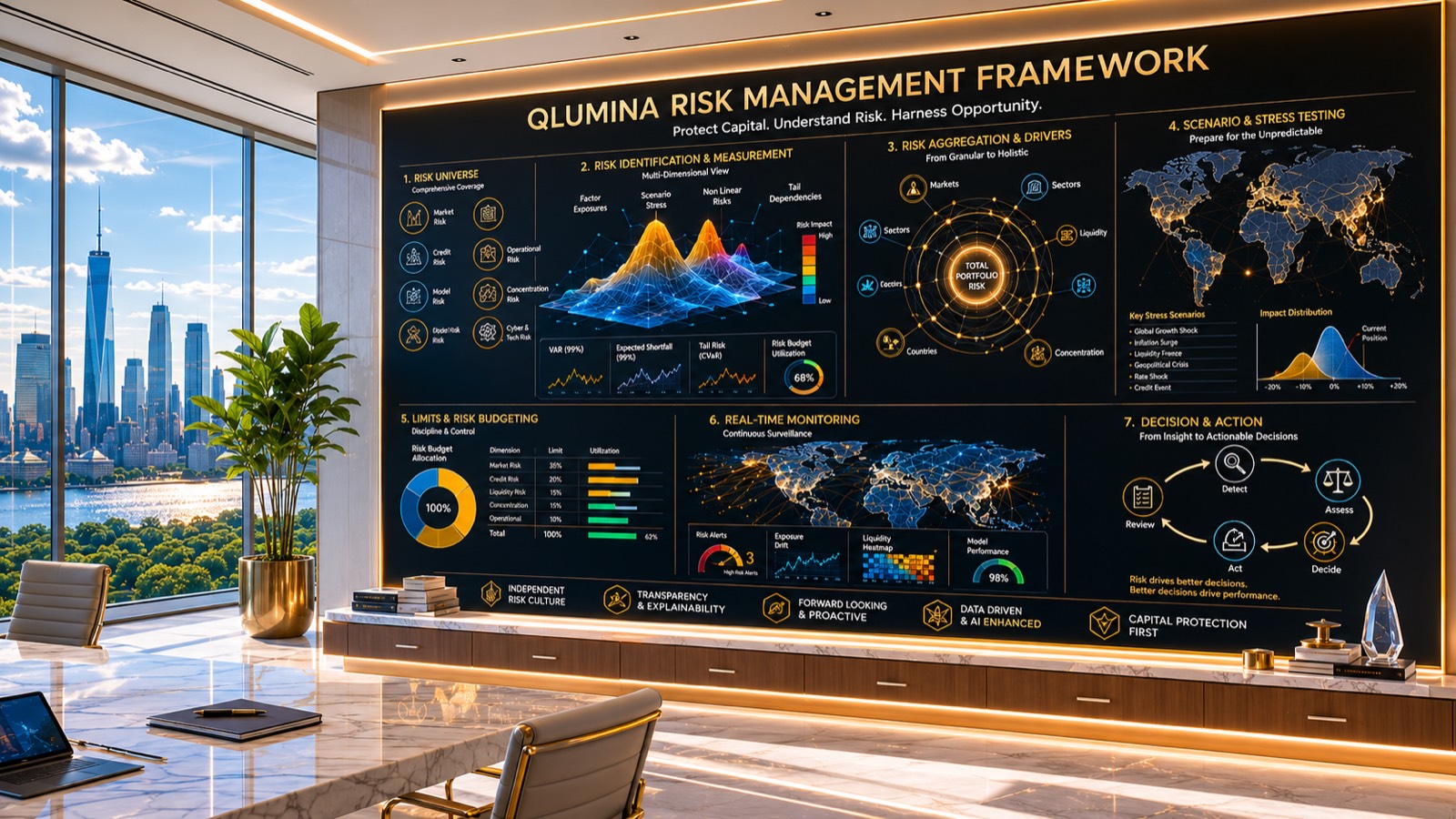
Qlumina integrates machine learning and algorithmic data pipelines across strategy research, manager sourcing, and real-time risk oversight. AI operates as a powerful accelerant to human judgment — it never replaces human fiduciary oversight.

01

Research & Discovery

Deep data analysis, feature extraction, and automated factor testing across decades of tick-level market data.

02

Manager Evaluation

Algorithmic verification of timestamped fills, detecting overfitting, hidden regime bias, and tail risks.

03

Real-Time Monitoring

Live factor drift tracking, automated intraday VaR boundary enforcement, and liquidity regime classification.

04

Human-in-the-Loop

All portfolio allocations, capital adjustments, and risk parameters require veteran human fiduciary sign-off.

Model validation & anti-overfitting controls

Quantitative research is guarded by rigorous walk-forward cross-validation, out-of-sample stress testing across disparate market regimes (including the 2008 Global Financial Crisis, 2020 Liquidity Shock, and 2022 Inflationary Cycle), and combinatorial purged cross-validation to prevent data snooping and look-ahead bias.

Chapter 07

Investment Strategies

Qlumina structures strategies across multiple systematic alpha families, each calibrated for distinct volatility regimes, holding periods, and liquidity profiles.

Systematic Trend & Macro

Medium-Term Trend (MFT)

Adaptive multi-horizon trend identification across 45+ liquid CME global futures. Designed for crisis alpha and sustained directional expansion.

Statistical Arbitrage

Market-Neutral Mean Reversion

Paired equity trades exploiting temporary statistical pricing dislocations in S&P 500 and Russell indices with strict beta neutrality.

Alpha Acceleration

High-Conviction Equity Momentum

Deep-learning regime classification isolating structural capital inflows into liquid US equities with disciplined weekly reconstitution.

Chapter 08

Performance Verification

Performance Verification

Performance verification is the bedrock of Qlumina's institutional credibility. We triangulate across multiple independent, non-correlated sources before presenting any strategy track record.

  • Administrator NAV Statements: Official reporting packages produced by regulated fund administrators.
  • Direct Prime Broker Statements: Trade confirmations and daily equity runs sourced directly from institutional clearing brokers.
  • Timestamped Tick-Level Trade Data: Every individual execution is analysed for slippage, latency, and fill veracity.
  • Live Pilot Capital Allocations: Deploying real capital within our proprietary ecosystem to verify execution veracity before public onboarding.
Chapter 09

Risk, Legal & Compliance

Capital Notice

Capital Is Not Guaranteed

Qlumina does not guarantee any return of capital or specific performance outcome. All quantitative and alternative investments involve substantial risk of loss, including the possible loss of principal.

Principal Institutional Risks

Market & Factor Risk

Adverse price movements, systemic liquidity dry-ups, and macro shocks.

Model & Parameter Risk

Algorithmic signal decay during unprecedented market regime shifts.

Counterparty Risk

Operational or financial distress at prime brokers, custodians, or issuers.

Execution & Slippage

Latency and spread widening during fast-moving macroeconomic events.

Chapter 10

Onboarding & Operations

Onboarding and Operations

Who is eligible

Qlumina accepts allocations strictly from Professional Investors, High-Net-Worth Individuals (net worth exceeding US$1,000,000 excluding primary residence), and Institutional Counterparties as defined under the BVI Securities and Investment Business Act, 2010 (SIBA). Retail clients are strictly prohibited.

Institutional KYC / AML Workflow

01

Identification

Government ID and corporate constitutional documentation.

02

Proof of Address

Official verification of registered address and tax residency.

03

Source of Wealth

Declarations compliant with BVI AML/CTF statutory regulations.

04

Eligibility Sign-off

Compliance review and formal institutional clearance.

Chapter 11

Legal & Disclaimers

General Risk Warning

Investing involves substantial risk of loss. The value of investments and the income derived from them can fall as well as rise, and investors may not recover the amount originally invested. Past performance is no guarantee of future returns. Nothing in this document constitutes financial, legal, tax, or investment advice.

Regulatory Status

Qlumina Inc. is incorporated in the British Virgin Islands as a BVI Business Company (No. 2201896) and approved by the BVI Financial Services Commission as an Approved Investment Manager under the Investment Business (Approved Managers) Regulations, 2012, Certificate No. IBR/AIM/26/2644.