

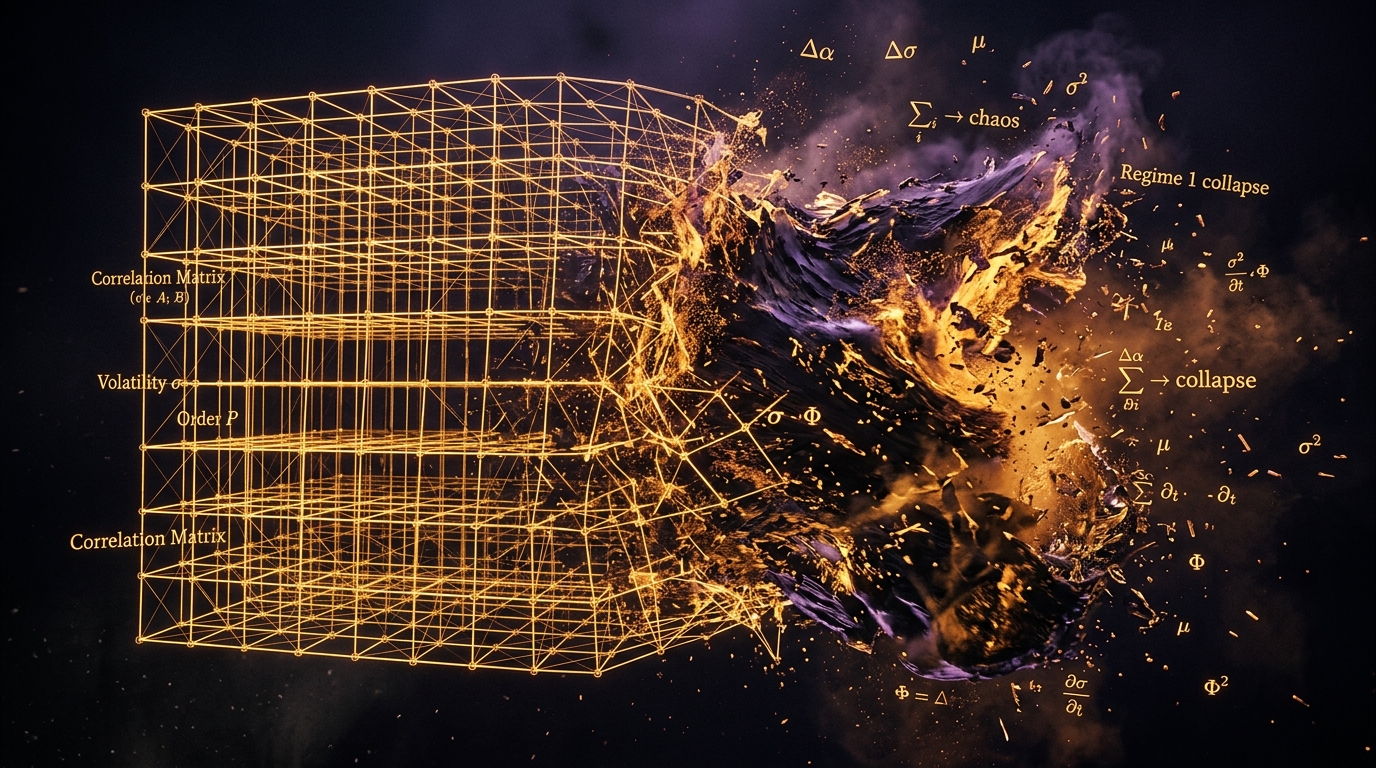
The rapid adoption of Large Language Models (LLMs) and transformer architectures in financial time-series forecasting has precipitated an unprecedented rate of out-of-sample failure. Industry backtests routinely report annualized Sharpe ratios exceeding 2.80, yet live deployment yields immediate regime collapse—manifested as steep tail drawdowns during volatility spikes, order-flow inversion, and macro transitions. This monograph investigates the structural mechanisms underlying this divergence: autoregressive error accumulation across low signal-to-noise distributions, pervasive lookahead leakage in sub-word tokenizers and financial corporate embeddings, and the fatal absence of physical causal state-space invariants. We formalize the mathematical and operational framework required to insulate systematic capital against catastrophic non-stationary distribution shifts.
1. The Fallacy of Static Manifolds in Non-Stationary Markets
Unlike computer vision or natural language processing where physical realities and linguistic syntax exhibit stationary underlying structures, financial markets are adaptive, adversarial multi-agent games. When an autoregressive model minimizes next-token cross-entropy conditioned on past observations, it assumes the empirical data manifold remains structurally invariant.
In protracted low-volatility regimes, autoregressive token prediction functions as a high-dimensional momentum proxy, generating flattering paper metrics. However, the transition matrix between market volatility regimes is non-stationary:
When liquidity evaporates, term structures invert, or central bank balance sheets shift, the return-generating manifold mutates instantaneously. Lacking physical inductive priors, autoregressive transformers extrapolate previous trend dynamics directly into structural discontinuities, leading to severe capital drawdowns.
Mathematical Proof of Non-Lipschitz Distribution Rupture
In classical statistical learning theory, bounded out-of-sample generalization error relies on the assumption that the underlying target mapping f : X → Y satisfies a bounded Lipschitz continuity condition:
In financial microstructure and macroeconomic regime transitions, the effective Lipschitz constant L is unbounded (L → ∞). A 1-basis-point surprise in sovereign yield auctions or an unexpected central bank interest rate hike triggers instantaneous, discontinuous liquidation across leveraged participants. When L is unbounded, Rademacher complexity and Vapnik-Chervonenkis generalization bounds disintegrate, causing deep neural networks to produce arbitrarily catastrophic errors in live production.
2. The Autoregressive Error Compounding Theorem
Standard decoder-only transformer architectures generate multi-step sequential predictions autoregressively: each predicted step ŷt+1 is concatenated to the context window to forecast ŷt+2.
In financial forecasting, every discrete prediction carries an irreducible observation and estimation error εt ~ D(0, σ2). When predicting across a multi-step forecast horizon H:
Because financial time series exhibit notoriously low signal-to-noise ratios (often below 0.05 on daily return horizons), compounding error variance explodes exponentially with the forecast horizon. By step t+3, the transformer's attention layers are attending primarily to its own previously generated hallucinations rather than true market order flow.
3. Hidden Contamination: The Embedding Leakage Problem
The vast majority of commercial quantitative AI platforms rely on pre-trained foundation models to parse corporate filings, earnings call transcripts, and macro news feeds. Forensic auditing reveals four systematic vectors of lookahead contamination:
| Contamination Vector | Mechanism of Leakage | Typical Backtest Flattery | Institutional Remediation |
|---|---|---|---|
| Sub-Word Tokenizers | BPE vocabularies trained on post-2022 corpora encode future corporate mergers, bankruptcy ticker symbols, and restructuring terms into historical 2012 text. | +0.60 to +1.10 Sharpe | Time-gated tokenizers built strictly on contemporaneously available corpora. |
| SEC Restatements | Automated scrapers ingest amended 10-K/A reports retroactively, granting models impossible historical foresight regarding corporate accounting distress. | +0.45 to +0.85 Sharpe | Immutable dual-timestamped EDGAR repository (T_event vs T_knowledge). |
| Cross-Sectional Normalization | Z-score calculations across expanding lookback windows leak statistical moments from future time periods into historical decision states. | +0.50 to +0.90 Sharpe | Combinatorial purged normalization with zero forward data visibility. |
| Post-Close Text Embeddings | LLM summaries integrate transcripts filed after market close into daily open-price predictors, fabricating synthetic predictive power. | +0.75 to +1.40 Sharpe | Sub-second timestamp validation against exchange matching engine clocks. |
4. Institutional Defense: Causal State-Space Invariants
To eliminate regime collapse, factor discovery must be separated from unconstrained statistical curve-fitting. Systematic models must be constrained by causal state-space invariants modeled across Directed Acyclic Graphs (DAGs):
- Directed Acyclic Graph (DAG) State Partitioning: Rather than relying on simple rolling moving averages, regime states are partitioned across an acyclic graph incorporating order-book queue depletion, cross-currency basis swaps, and sovereign debt term structure slopes.
- Fail-Closed Basis Scaling: When market state uncertainty exceeds an empirical entropy threshold, allocations automatically de-risk to collateralized cash or risk-neutral basis rather than forcing a probabilistic forecast.
- Decoupled Execution Verification: Trading signals generated in research never execute directly. They must pass through the compiled C++ Blitz engine, where hard pre-trade margin caps and drawdown circuits operate at the bare-metal level.
Mathematical Formulation of the Causal State Space
The continuous state space is governed by a state transition equation with endogenous regime switches:
Where Rt denotes the discrete macro volatility regime and st represents latent market state. By running an adaptive Kalman filter in tandem with the DAG graph, the system computes the exact Mahalanobis distance DM(xt) between live execution tape and the historical training manifold:
5. The 5-Stage Ultron Research Validation Pipeline
To eliminate human curve-fitting and commercial bias, all quantitative models powering Qlumina portfolios undergo the institutional 5-stage Ultron validation pipeline:
Lookahead & Token Contamination Audit
Strict verification that sub-word tokenizers and financial text corpora do not encode future corporate naming events, splits, or post-close disclosures into historical timestamps.
Non-Stationary Transition Detection
Partitioning market states via Directed Acyclic Graphs (DAG) incorporating cross-asset order flow, sovereign yield term structures, and liquidity dispersion rather than static rolling windows.
Combinatorial Purged Cross-Validation
Eliminating serial autocorrelation leakage by strictly purging overlapping evaluation horizons and enforcing empirical time embargo buffers across every test split.
Counterfactual Placebo Falsification
Phase-scrambling empirical price series to verify candidate alpha decays to zero under power-spectrum-preserving noise, rejecting spurious statistical curve fits.
Deterministic Pre-Trade Gate Staging
Translating mathematical alpha factors into compiled, bare-metal state machines managed by the Blitz execution core with hard pre-trade margin and volume invariants.
6. Empirical Crisis Autopsies: Where Transformer Alpha Failed
Case Study I: The 2022 Global Rates Inversion Shock
Throughout the post-2008 quantitative easing era, equity-bond correlation was persistently negative (ρ ≈ -0.35). Deep transformer models trained on 2010–2021 financial text embeddings learned an implicit prior: when equity markets sell off, fixed income assets appreciate, serving as an automatic portfolio hedge.
In 2022, as global central banks initiated aggressive rate hikes to combat persistent inflation, the macro regime ruptured. The equity-bond correlation flipped violently positive (ρ ≈ +0.65). Transformer-based multi-asset strategies suffered severe concurrent drawdowns across both sleeves, failing to recognize that inflation-driven rate shocks invert the traditional cross-asset manifold.
Case Study II: The August 2024 Japanese Yen Carry Trade Unwind
In early August 2024, the Bank of Japan implemented an unexpected 15 basis point rate increase, triggering a historic liquidation of the global Japanese Yen carry trade. Over a 72-hour window, the USD/JPY pair plummeted by more than 12%, triggering automated margin calls across global macro hedge funds.
LLM models evaluating news headlines and fundamental metrics failed completely: while US macroeconomic fundamentals remained stable, cross-border liquidity plumbing caused forced liquidations across Japanese equities (Nikkei 225 dropped -12.4% in a single session) and US tech megacaps. Autoregressive language models that lacked real-time visibility into cross-currency basis swaps and repo funding pipelines were completely blind to the liquidation cascade.
7. Institutional Due Diligence: 6 Critical Questions for Allocators
Family offices and sovereign allocators conducting due diligence on systematic AI funds should require written answers to the following forensic questions:
Institutional Synthesis: Defending Against Distribution Rupture
The catastrophic failure rate among generative AI and LLM financial models is neither random nor unavoidable. It is the direct consequence of treating financial markets as stationary linguistic corpora rather than non-stationary, adversarial multi-agent games.
By enforcing immutable point-in-time tokenization, purging forward serial correlation through combinatorial embargoes, bounding risk via physical causal state-space invariants, and delegating trade execution strictly to compiled bare-metal deterministic engines, institutional allocators can insulate their capital from regime collapse and harvest genuine, un-curve-fitted structural alpha.
Inspect the Ultron Research Pipeline.
Access institutional whitepapers, Walk-Forward efficiency datasets, and live pre-trade risk audit logs for qualified family offices and endowments.