

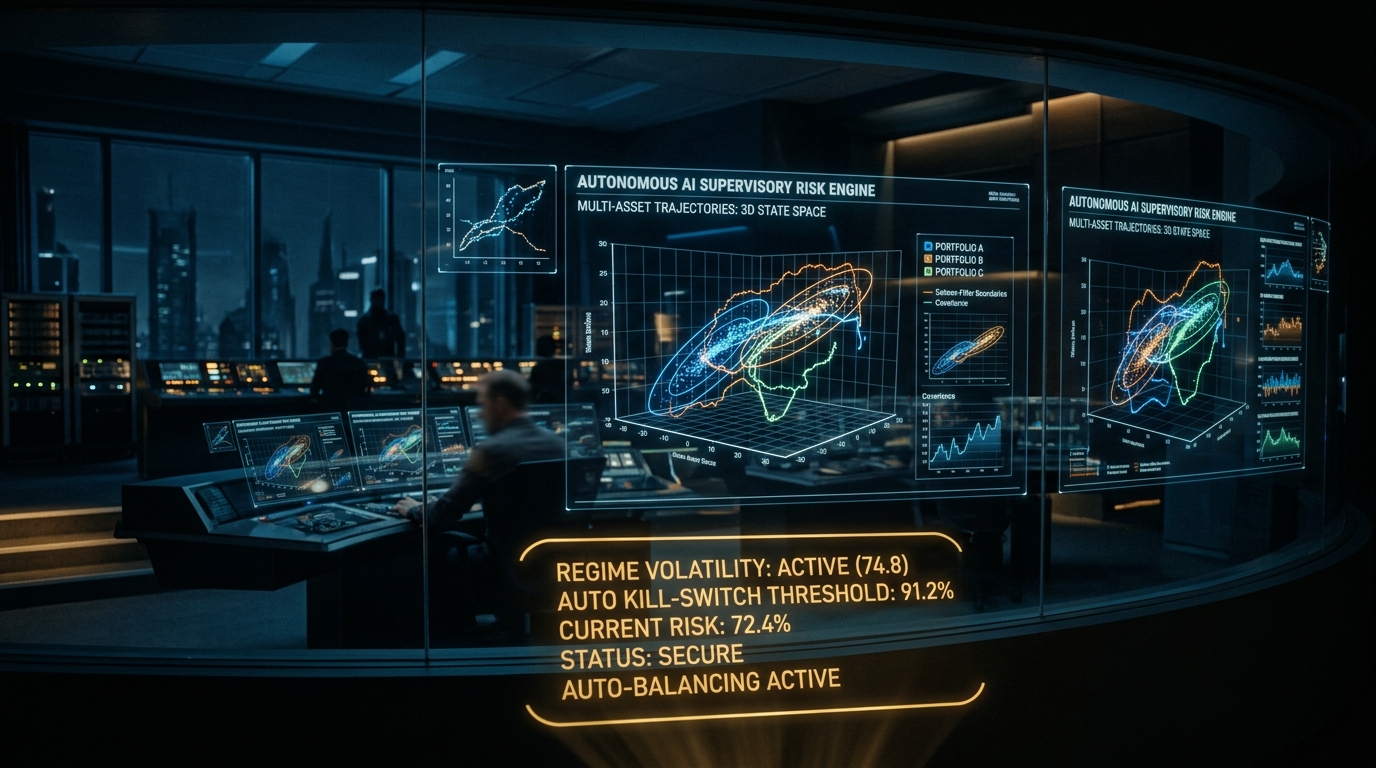
In conventional algorithmic trading, risk management is treated as an afterthought: a rigid, mechanical stop-loss order placed at a fixed percentage below the entry price. In adversarial institutional markets, static stops represent visible liquidity pools that predatory high-frequency algorithms routinely hunt and trigger during transient spread widenings. This monograph details the transition from mechanical stops to Active AI Supervisory Layers: continuous state-space monitoring that invalidates positions based on macroeconomic thesis decay, cross-asset correlation fractures, and order-book entropy shifts, cutting risk before catastrophic drawdowns occur.
1. The Mechanical Stop-Loss Fallacy
A mechanical stop-loss assumes that price is the sole metric of whether a trading decision was correct. If a strategy purchases a contract at $100 with a stop at $97, it remains fully exposed through $99, $98, and $97.50—even if the underlying macroeconomic catalyst that justified the trade vanished thirty seconds after entry.
Worse, in modern electronic markets, clustered stop-loss orders are visible to market makers through order book depth analysis. During illiquid sessions (such as the market cross or macroeconomic data releases), liquidity sweeps artificially depress price to trigger resting stops, absorbing forced seller liquidity before price violently reverts.
2. The Cognitive State Invalidation Thesis
Under Qlumina's supervisory architecture, a trading position is modeled as a living scientific hypothesis. It is permitted to remain active only as long as its underlying causal conditions persist:
If the relationship fractures, the supervisory layer emits an invalidation command, initiating orderly position liquidation regardless of current PnL.
3. The 4-Stage Supervisory Monitoring Loop
Operating asynchronously outside the microsecond execution path, the Ultron Cognitive Supervisory Layer executes continuous state evaluations across four distinct vectors:
Causal Premise Verification
Every open position is continuously evaluated against its initial entry thesis. If the order-book imbalance or macroeconomic yield curve slope that justified the trade dissipates, the position is liquidated immediately—regardless of whether PnL is positive or negative.
Cross-Asset Correlation Fracture Detection
Monitoring high-frequency correlation vectors between equities, rates, and credit spreads. When historical covariance matrices break down (signaling an unobserved regime transition), supervisory circuits de-risk sleeve exposure to neutral basis.
Order-Book Microstructure Entropy Tracking
Measuring Shannon entropy across Level-2 depth. A sudden collapse in resting liquidity depth or an exponential spike in cancel-to-fill ratios triggers proactive inventory reduction before spread-widening cascades occur.
Pre-Emptive Soft Invalidation
Instead of waiting for a mechanical stop-loss to be hunted by aggressive high-frequency market participants, the supervisory layer scales out position inventory via passive liquidity posting during transient counter-trend bounces.
4. Fail-Closed Basis Scaling: Graceful Degradation
What happens when market volatility explodes and models cannot establish high-confidence regime states? Traditional quantitative strategies continue trading, relying on historical parameters that no longer apply to the new distribution.
The Qlumina supervisory layer implements Fail-Closed Basis Scaling: allocations scale down dynamically proportional to state uncertainty. If model entropy crosses critical thresholds, portfolio exposure compresses automatically to cash or risk-neutral basis, preserving capital while competitors absorb tail liquidation shocks:
5. Institutional Due Diligence: 5 Forensic Questions for Allocators
Fiduciary allocators, single-family offices, and risk governance committees should require written documentation addressing these 5 active supervisory questions:
Institutional Synthesis: Protecting Capital Through Causal Awareness
Mechanical stop-losses are relics of an analog era, creating predatory targets for modern high-frequency liquidity sweeps. Real risk governance requires continuous evaluation of the causal economic hypothesis underpinning each trade.
By coupling real-time order-book entropy tracking with fail-closed basis scaling, Qlumina ensures portfolios de-risk into collateralized cash before volatility spikes transform into catastrophic drawdowns.
Inspect Our Supervisory State Machine Architecture
Fiduciary trustees, risk committees, and institutional allocators can examine our state transition diagrams, Shannon entropy indicators, and historical crisis de-risking logs within our secure data room.